Why SRS Works: The Science Behind Remembering Japanese Vocabulary
Spaced repetition is memory science applied to language learning. Here's how it works and why it beats every other vocabulary method.
The Forgetting Problem
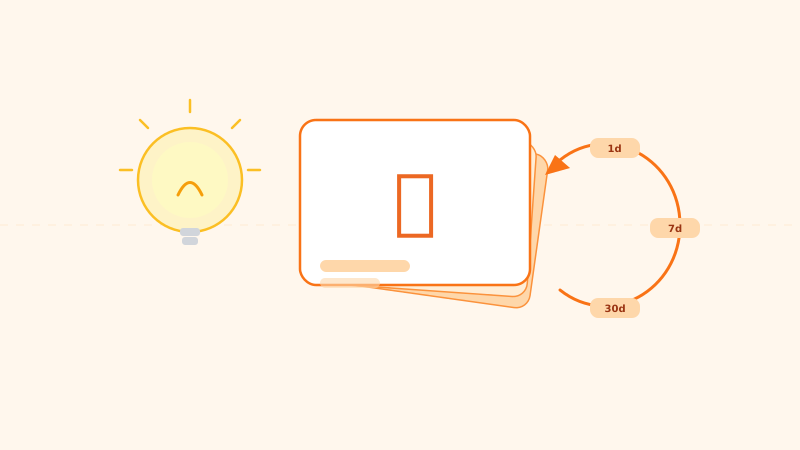
You study 20 new Japanese words. You remember most of them the next day. By day 7, half are gone. By day 30, nearly all of them have faded.
This is normal. It's not a sign that you're bad at languages. It's how memory works — and understanding it is the key to fixing it.
The Forgetting Curve
In 1885, psychologist Hermann Ebbinghaus mapped how memory decays over time. His forgetting curve showed that without reinforcement, we forget roughly:
- 40% of new information within 20 minutes
- 60% within 1 hour
- 75% within 24 hours
- 90% within a week
The curve isn't fixed, though. Every time you successfully recall something, the forgetting curve resets and flattens. You forget it slower the next time.
How Spaced Repetition Works
Spaced Repetition Systems (SRS) exploit this by timing reviews to hit just before you'd naturally forget.
| Review | Time After Previous |
|---|---|
| First review | 1 day |
| Second review | 3 days |
| Third review | 1 week |
| Fourth review | 2 weeks |
| Fifth review | 1 month |
| Sixth+ review | 3+ months |
If you answer correctly, the interval grows. If you struggle or forget, it resets shorter. Over time, items you know well appear rarely. Items you're weak on appear often.
Why Anki (and Similar Apps) Work
Anki is the most widely used SRS tool for language learners. After each card you rate yourself:
- Again — I forgot. Reset to short interval.
- Hard — I remembered but it was difficult. Small interval increase.
- Good — I remembered comfortably. Standard interval increase.
- Easy — Very easy. Large interval jump.
Your honest self-rating is what makes the system work. Marking things "easy" when they're not trains the algorithm wrong.
SRS for Japanese Specifically
Japanese vocabulary learning has a specific challenge: you're learning three things per word — the kana/kanji form, the reading, and the meaning.
Good Japanese SRS decks test all three directions:
- Recognition cards: Show kanji → recall reading + meaning
- Production cards (advanced): Show English → produce Japanese
Start with recognition. Production can wait until you have a solid base.
Core N5 Vocabulary Decks
For JLPT study:
- JLPT N5 Core 800 — the roughly 800 words tested at N5
- Genki vocabulary decks — aligned to the Genki textbook series
- Core 2000 — the 2,000 most frequent words in Japanese
What SRS Doesn't Do
SRS handles memorization. It doesn't teach you how to use words in sentences, understand spoken Japanese at speed, or grasp grammar patterns in context.
Think of SRS as building the vocabulary bank. You still need structured grammar lessons, listening practice, and reading practice.
Daily Habit, Not Marathon Sessions
The research is clear: distributed practice outperforms massed practice. Thirty minutes of SRS daily beats three hours on Saturday every time.
A sustainable routine:
- 20-30 new cards per day (beginners)
- Clear your reviews before adding new cards
- Never skip reviews — the pile grows fast
- Use the same app on mobile for review anywhere
The habit is the system.