Learn Radicals First: The Smarter Path Through Kanji
Brute-force kanji memorization stops working at 200 characters. Learning radicals first means every new kanji has structure, not just another random shape.
The Standard Approach (And Why It Fails)
Most learners approach kanji by brute force: write it 20 times, try to remember the shape, forget it by next week.
This works for maybe the first 50 kanji. By kanji 200, the characters start blurring together. By 500, you're drowning.
The problem isn't memory — it's that kanji look arbitrary when you don't know their components. They're not.
What Are Radicals?
Kanji are built from components called radicals (部首, ぶしゅ, bushu). Japanese dictionaries organize kanji by radical — it's the original filing system before digital search.
There are 214 official Kangxi radicals, but you don't need all of them. For JLPT study, knowing the 80-100 most common radicals covers the vast majority of kanji you'll encounter.
Why Radicals Change Everything
With radicals, kanji stop being random squiggles and become structured patterns.
Consider the water radical 氵 (three dots on the left):
- 海 (うみ) — sea
- 泳 (およぐ) — swim
- 池 (いけ) — pond
- 洗 (あらう) — wash
- 湖 (みずうみ) — lake
All water-related. The radical tells you something about the meaning before you even look up the word.
The tree radical 木 (き):
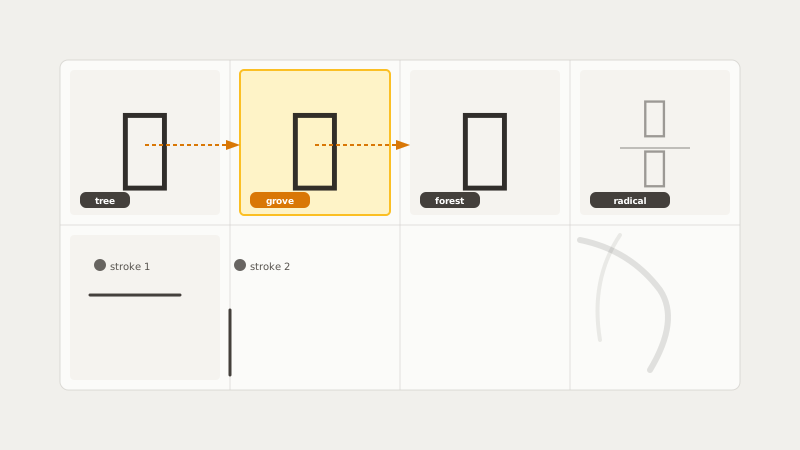
- 木 → 林 (grove) → 森 (forest): more trees = denser forest
- 机 (つくえ) — desk (wooden surface)
- 椅子 (いす) — chair (wooden seat)
Semantic vs. Phonetic Components
Kanji have two types of components:
Semantic radicals hint at meaning (like the examples above).
Phonetic components hint at reading. For example, the component 青 (sei/shou) appears in:
- 清 (きよい) — clear/pure
- 情 (じょう) — emotion
- 請 (こう) — request
Not perfect, but helpful when guessing an unfamiliar reading.
The High-Value Radicals to Learn First
| Radical | Meaning hint | Example kanji |
|---|---|---|
| 人 / 亻 | person | 休 仕 他 |
| 口 | mouth/say | 言 語 話 |
| 手 / 扌 | hand | 持 打 |
| 水 / 氵 | water | 海 泳 洗 |
| 木 | tree | 林 森 机 |
| 日 | sun/day | 明 時 晴 |
| 心 / 忄 | heart/emotion | 思 感 |
| 土 | earth | 地 場 |
| 火 / 灬 | fire | 炎 焼 |
| 言 | word/say | 語 読 |
How to Actually Learn Radicals
Don't study radicals as an abstract list. Learn them by encountering them in real kanji:
1. Pick 10 high-frequency kanji you're studying 2. Identify the main radical in each 3. Find 2-3 other kanji that share that radical 4. Note the meaning connection
This builds a network, not a list. Networks are what memory is made of.
Does This Work for JLPT Kanji?
For N5 (100 kanji) and N4 (300 kanji), yes — the radicals are clearer and the meaning connections are more direct.
For N2 and N1, kanji get more complex and phonetic components become more useful. But by then, you'll have developed intuition for the patterns anyway.
Start with radicals. The habit of looking for components — asking "what is this kanji made of?" — is one of the highest-leverage skills in Japanese study.